
-
您身边的网站建设推广专家
专注营销型网站建设 . 搜索引擎全网覆盖推广 . 打造移动互联网
全国咨询热线
【建站服务】渠县网站推广【渠县办理400电话】渠县SEO优化、渠县微信公众号APP客户端小程序开发、渠县网站托管、渠县APP开发-域名申请
作者: 风兰 . 阅读量: 3 . 发表时间:2022-09-20 16:00:13
上往建站提供服务器空间服务商,百度快照排名,网站托管,百度推广运营,致力于设计外包服务与源代码定制开发,360推广,搜狗推广,增加网站的能见度及访问量提升网络营销的效果,主营:网站公司,百度推广公司电话,官网搭建服务,网站服务企业排名,服务器空间,英文域名等业务,专业团队服务,效果好。
渠县网站推广【渠县办理400电话】渠县SEO优化、渠县微信公众号APP客户端小程序开发、渠县网站托管、渠县APP开发

渠县,隶属于四川省达州市,位于四川省东部、达州市西南部,地处渠江流域核心区,与广安、南充、巴中山水相连,总面积2018平方千米。 [1] 截至2019年,渠县下辖37个乡镇(街道) [2] ;户籍人口150万人,常住人口111.61万人。 [3-4]
渠县早在新石器时期便有了人类活动,殷商时期賨人在今土溪镇城坝村建立了国都城,周赧王元年(前314年)设置宕渠县,明洪武九年(1376年)定名渠县,还曾建置郡、州治地,相当长的历史时期是川东北政治、经济、文化的中心。享有“汉阙之乡、黄花之乡、竹编艺术之乡、诗歌之乡、民间文化艺术之乡、诗词之乡”等6张全国名片,是全国粮食生产先进县、生猪调出大县、牛羊基地大县,全省首批扩权强县试点县、工业强县示范县,农民增收工作先进县,三度荣膺中国西部百强县,2019年荣获全省县域经济发展先进县第一名。 [3]
2019年,渠县地区生产总值338.6亿元;地方公共财政收入12.5亿元,主要经济指标增速稳居达州市市“第一方阵”,绝对值位居四川省35个农产品主产区县前列。
Requires npm version 5.5.1 or greater
To meet the increasing need for strong digital security, npm introduced two-factor authentication (2FA) with version 5.5.1. Two-factor authentication prevents unauthorized access to your account by confirming your identity using two methods:
something you know (such as your username and password)
something you have (such as a phone or tablet)
For example, if your bank uses 2FA, the first time you logged in to your online banking system, the bank sent a code to your cell phone number, then prompted you to enter the code online. This proved that the cell phone was in your possession, and linked it to your account for authentication. After that, whenever the bank detects anything unusual, such as a login from a different laptop, it will send a temporary code to your phone that you must enter before you can login. This provides an extra layer of security because, even if someone obtains your login credentials, they are unlikely to have your device in their possession as well. Even if someone finds your phone, they are unlikely to also be able to hack your laptop's password.
Two-factor authentication multiplies the protection against attacks, and we recommend that you implement this with your npm account.
To enable 2FA with your npm account, you will need an application that can generate a One Time Password, or OTP. For example, Authy or Google Authenticator, can generate one time passwords (OTP's). These products use a Time-Based One-Time Password Algorithm (TOTP) to create temporary codes. Install the application on a mobile device or a second laptop that will always be available when you work in your npm account. (Note: npm does not use SMS (text-to-phone) as a method for authenticating users.)
There are two levels of authentication, auth-only and auth-and-writes.
If you enable 2FA in auth-only mode, npm will require an OTP when you:
log in
remove 2FA
If you enable 2FA in auth-and-writes mode, which is the default, npm will require an OTP when you:
log in
change your profile
create or revoke tokens
publish packages
change access
change your password
make other sensitive changes to packages
remove 2FA
To add the OTP to a command, append it as shown:
npm owner add <user > --otp=123456
Other examples are listed below.
To require two-factor authentication, type the command that meets the level of security you wish to apply (auth-and-writes is the default).
    npm profile enable-2fa
    npm profile enable-2fa auth-and-writes
    npm profile enable-2fa auth-only
npm will return this message:
npm notice profile Enabling two factor authentication for auth-and-writes
or this message:
> npm notice profile Enabling two factor authentication for auth-only
depending on the setting you provided.
Next, npm will display a QR code:
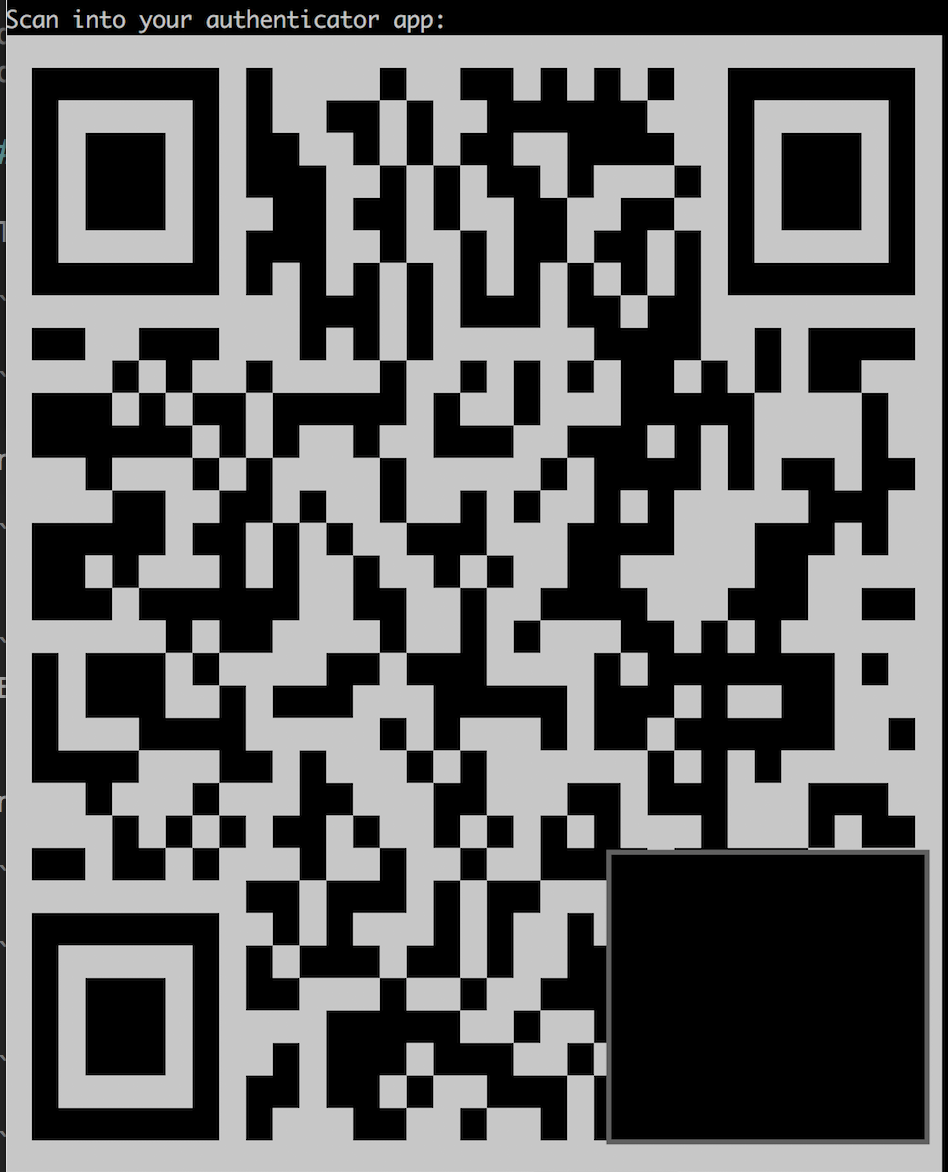
Add a new account to your authenticator app.
Scan the QR code, or enter the number displayed just below the QR code.
This will configure the authenticator app for future use, linking authentication to the device that generated the authentication.
Using your authenticator app, enter an OTP at the prompt shown:
Add an OTP code from your authenticator:
After you have entered the one-time password, npm will display this message:
2FA successfully enabled.
Below are your recovery codes, please print these out.
You will need these to recover access to your account
if you lose your authentication device.
After you have applied two-factor authentication, you can use the npm profile get command to confirm that it has been set.
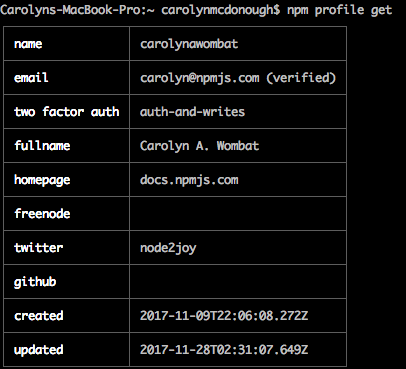
Once you have installed 2FA, you will need to enter an OTP for security-relevant commands. For example, whenever you use the command npm profile set you will need to enter an OTP before you can set or change a value, such as your fullname:
$npm profile set fullname Carolyn A. Wombat
Enter OTP: 567452
Set fullname to Carolyn A. Wombat
Use `npm profile get' to confirm the new setting.
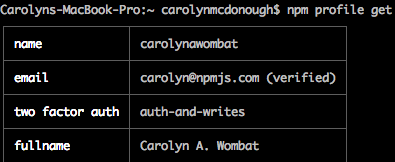
Note to our readers: We have reset the account used in screen shots; neither the QR nor the codes are still active. But thank you to those alert and kind wombats who have asked us about this.
As described above, after you set up two-factor authentication, a series of recovery codes will appear on your screen. Please print them and save them as described. Note: Some authenticator applications provide a method for you to store recovery codes.
Tip: Save these codes in a different location than the device you use to authenticate. For example, if you get your OTP from a tablet, don't save the codes in a case with your tablet.
The recovery procedure is explained below.
To remove 2FA from your profile, type this command:
npm profile disable-2fa
npm will prompt for your password:
> npm password:
Enter your npm password as prompted, then npm will display:
>Enter one-time password from your authenticator: 123456
npm will confirm:
Two factor authentication disabled.
If you have enabled 2FA auth-and-writes, you will need to send the OTP from the command line for certain commands. To do this, append --otp=123456 (where 123456 is the code generated by your authenticator) at the end of the command. Here are a few examples:
npm publish [<tarball>|<folder>][--tag <tag>] --otp=123456
npm owner add <user > --otp=123456
npm owner rm <user> --otp=123456
npm dist-tags add <pkg>@<version> [<tag>] --otp=123456
npm access edit [<package>) --otp=123456
npm unpublish [<@scope>/]<pkg>[@<version>] --otp=123456
If you cannot locate the device that provided second-factor authentication:
Find the recovery codes you saved when you enabled 2FA.
If you are logged out, login normally using your login and npm password. When prompted for an OTP, enter a recovery code. (Note that this might create a second authenticator account with the same npm account name. Be sure to use the newly created account.)
Once you are logged in, type npm profile disable-2fa and enter your npm password if prompted.
Enter an unused recovery code when you see this prompt:
>Enter one-time password from your authenticator:
npm will confirm that two-factor authentication has been disabled.
type npm profile enable-2fa to re-enable 2FA, assign a different device to your account, and generate new recovery codes.
If you have misplaced your recovery codes, please contact npm customer support.
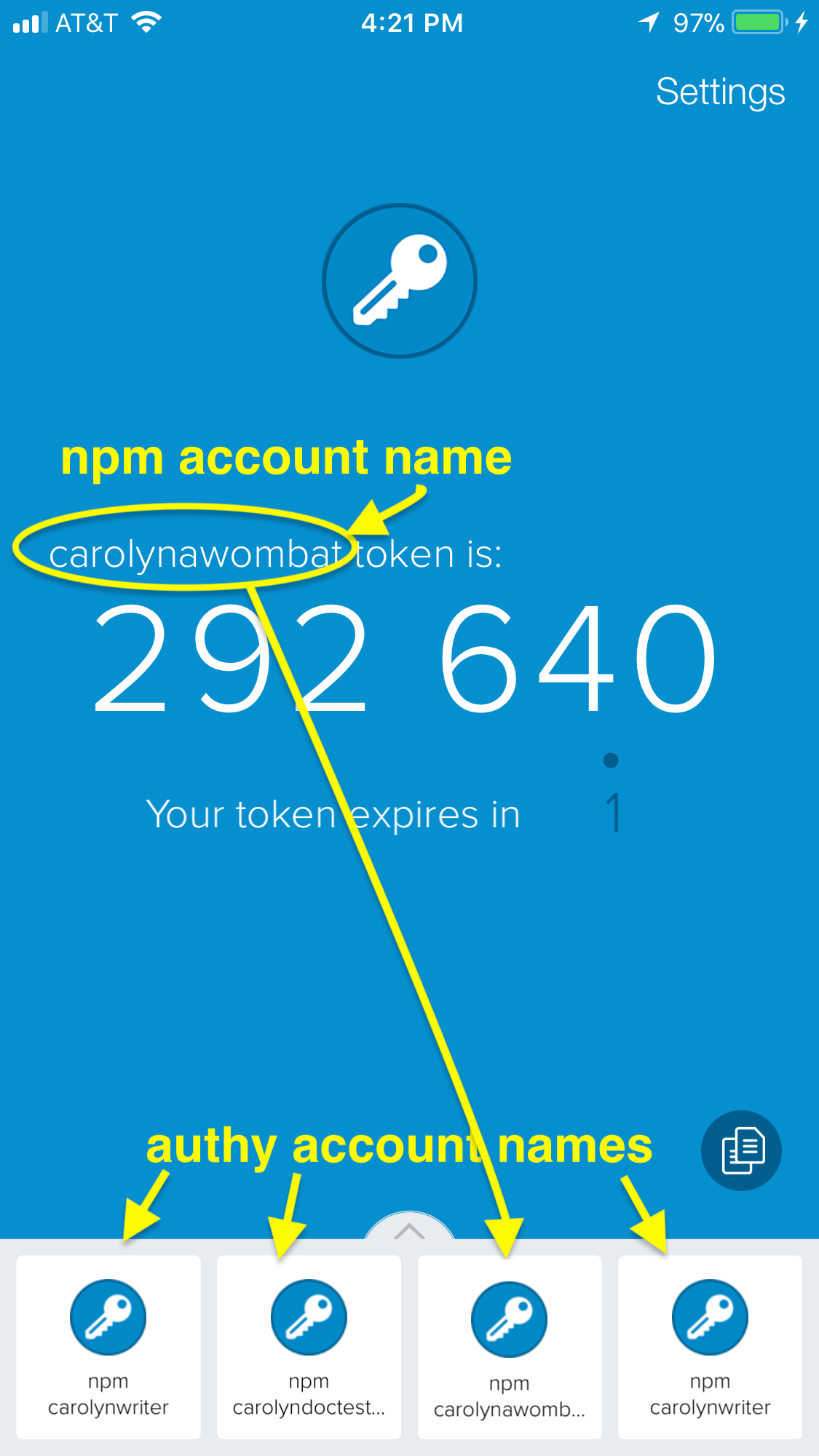
If you are entering what seems to be a valid OTP but you see an error, be sure that you are using the correct authenticator account. In the screen shot below, the current account in Authy was set incorrectly because the developer had multiple npm test accounts. This will cause the OTP to fail. Also, as stated earlier, when you reset 2fa after it has been disabled, the authenticator might create a second account with the same name. Please see the authenticator documentation to delete the old account.
Settings you define using the Command Line Interface (CLI) will also apply to the website. At this time, you cannot activate 2FA from web interface.
渠县网站推广【渠县办理400电话】渠县SEO优化、渠县微信公众号APP客户端小程序开发、渠县网站托管、渠县APP开发
上往建站提供搭建网站,域名注册,官网备案服务,网店详情页设计,企业网店,专业网络店铺管理运营全托管公司咨询电话,服务器空间,微信公众号托管,网页美工排版,致力于域名申请,竞价托管,软文推广,全网营销,提供标准级专业技术保障,了却后顾之忧,主营:虚拟主机,网站推广,百度竞价托管,网站建设,上网建站推广服务,网络公司有哪些等业务,专业团队服务,效果好。
服务热线:400-111-6878 手机微信同号:18118153152(各城市商务人员可上门服务)

关键词:网站建设,企业网站,网站制作,网页设计,高端网站建设,企业网站制作,网页制作,制作网站,网站设计,高端网页设计,高端网站设计,做网站,自适应网站